
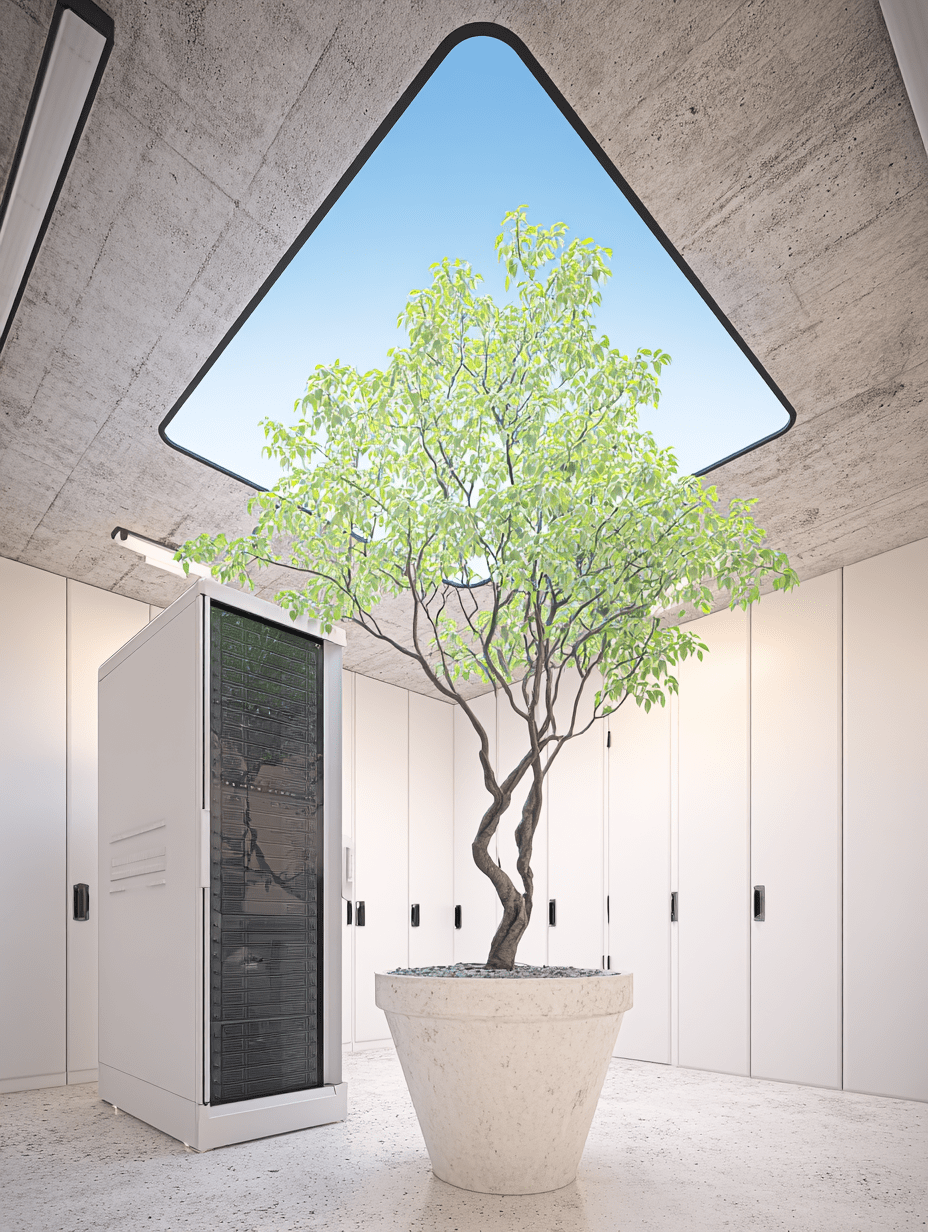
Most people don’t think about where the Internet actually lives. It’s not in one place—it’s everywhere. Distributed across roughly 12,000 data centers worldwide, with about half of them in the USA alone.
The scale is staggering. Microsoft operates over 4 million servers. Google runs around 900,000. That’s an enormous amount of computing power humming away, largely invisible to the billions of people who depend on it every day.
But what actually happens inside these digital fortresses?
My First Data Center: Welcome to the Bunker
The first time I visited a data center, I was struck by the security. Thick locks, cameras everywhere, clinical sterility. It felt like entering a bunker—the kind of airlock you’d imagine at the end of humanity, where nothing exists beyond except pure technology.
That Hollywood vision of machine rooms from The Matrix or Terminator? There are parallels, but reality is much more mundane. Like most places where fiction meets fact, the truth is more practical and less dramatic.
Once you’re inside, you’re surrounded by server cabinets called racks. These contain the real infrastructure: switches, routers, servers, and UPS systems to handle power fluctuations. Everything is interconnected through in-house cabling. Some connections meet in “MeetMe rooms,” others link directly to aggregated networks that form Internet Exchange Points—the critical junctions where different networks connect.
The Digital River
It’s cold throughout the entire facility. Every area is air-conditioned because servers need comfortable temperatures to function reliably. The background noise sounds like a digital river—perceptible but not overwhelming. It’s the sound of the Internet breathing.
Visiting data centers always gives me a profound feeling. Despite all the complexity, it comes down to something beautifully simple: computers talking to other computers. One machine, two machines, linked together, scaled up to support human civilization.
What If They All Stopped?
Here’s a sobering thought: What would happen if data centers went offline?
The answer is simple and terrifying. We’d lose everything digital. The Internet’s routing protocol (BGP) might still try to find the last available routes, but the truth is stark—if data centers are offline, we’re offline. No cloud services, no social media, no online banking, no Netflix (Gossshhh!), no GPS. Our digital lives would simply… stop.
The Future: Smarter, Greener, Closer
What excites me most is how data centers are evolving beyond just raw computing power. Innovation is happening in fascinating directions:
Microsoft experimented with underwater data centers in shipping containers, using ocean water for efficient cooling.
German companies are building hybrid facilities where waste heat powers algae farms. This isn’t just clever engineering—it’s environmental alchemy. One kilogram of algae consumes two kilograms of CO2 while thriving on that waste heat.
District heating systems are being integrated with data center waste heat, turning computational byproducts into community resources.
The most intriguing possibility? We’re probably heading toward mini data centers in our homes. Combined with better encryption and edge computing, your house could become part of the Internet’s infrastructure while handling your smart home needs and personal data storage.
More Than Technology Temples
Data centers aren’t just the engine rooms of the Internet—they’re critical infrastructure, as essential as power grids or water systems. They’re where the abstract concept of “the cloud” becomes physical reality: massive buildings full of humming machines that enable human connection across the globe.
The next time you stream a video, send a message, or check your bank account, remember: somewhere in a climate-controlled room, a server you’ll never see is working to make that moment possible.
That’s the invisible magic of our connected world—millions of computers in thousands of buildings, all working together to shrink distance and expand possibility.
Have you ever wondered what happens to your data after you hit “send”? The journey is more physical than you might think.


 Techland